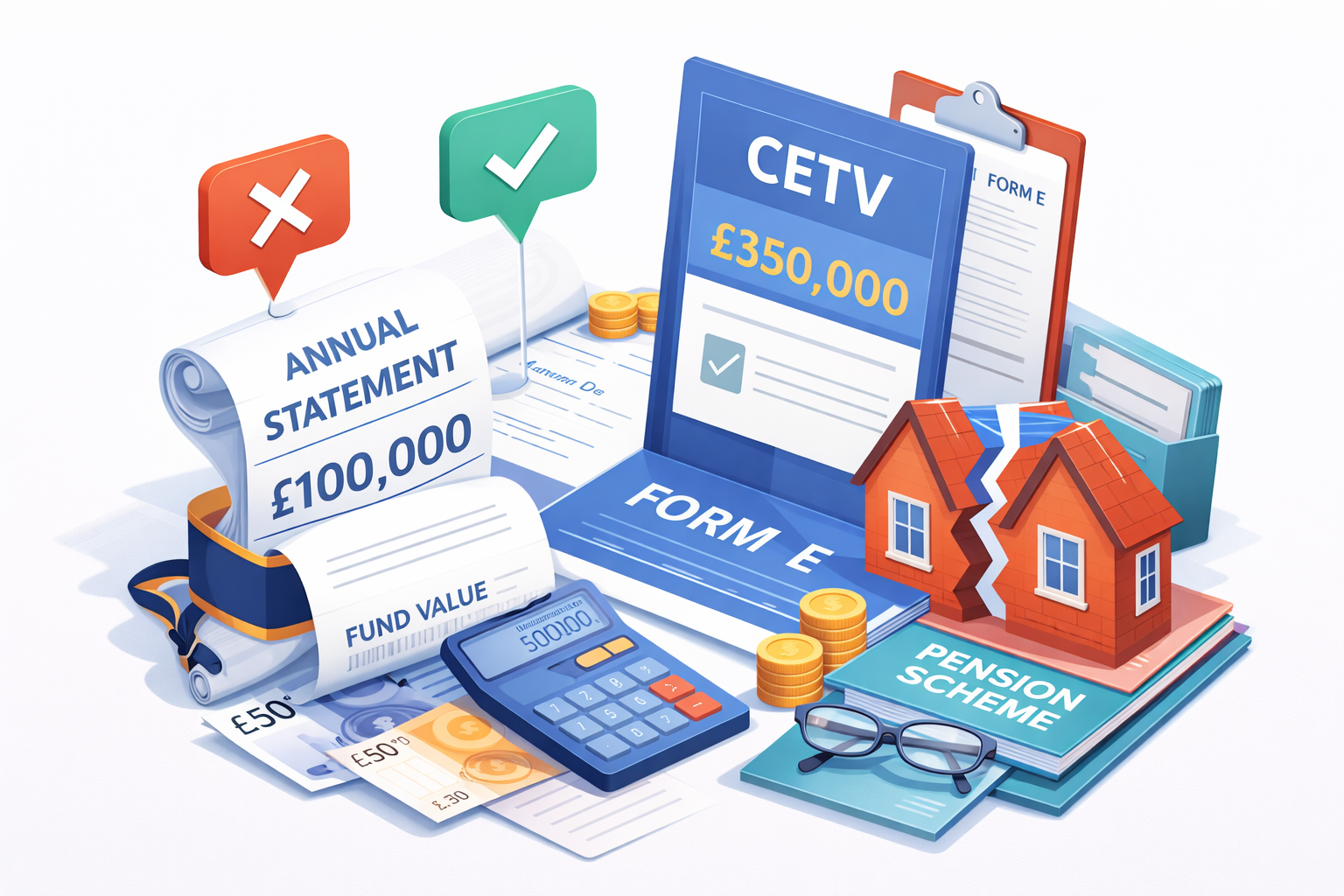
> **In one sentence:** For Form E, you'll usually need a CETV (transfer value) — not the "fund value" shown on your annual statement.
*This is general information, not legal or financial advice.*
---
Pensions are often the second largest asset in a marriage—sometimes worth more than the family home. Yet they're frequently valued incorrectly.
When filling out your Form E financial statement or using our [Divorce Settlement Calculator](/tools/divorce-settlement-calculator), you can't simply grab the "Fund Value" from your annual statement.
You usually need a specific number called the **Cash Equivalent Transfer Value (CETV)**. Using the wrong figure could cost you thousands in a settlement.
---
## The "Fund Value" Trap
Most people look at their annual statement or banking app and see a "current value" or "projected pot."
> **Example:** "Your pot is worth £100,000."
**Don't use this number.**
This figure is often just a projection or a face value. It doesn't account for exit fees, market adjustments, or the specific "transfer value" that the pension provider would pay out today.
For divorce disclosure, a CETV is the standard way pensions are valued—and it's usually what you'll be asked for. It represents the cash amount the scheme would typically offer as a transfer value at that time (sometimes subject to scheme adjustments).
---
## What is a CETV?
CETV stands for **Cash Equivalent Transfer Value**.
| Pension Type | What to Know |
|--------------|--------------|
| **Defined Contribution** (Private/Workplace) | The CETV is usually close to the fund value, but can differ |
| **Defined Benefit** (Final Salary/Public Sector) | ⚠️ **Critical.** The "annual income" you see (e.g., £20k/year) is meaningless for a capital split. You must request a CETV to convert that income stream into a capital value (e.g., £400,000) |
---
## How to Request Your CETV
Many schemes will provide one guaranteed CETV (or "statement of entitlement") free of charge every 12 months. Additional requests may incur a fee.
### Step-by-Step
**1. Contact your provider**
Call them or log in to your online portal.
**2. Use this exact script:**
> "Please provide my CETV / statement of entitlement as at the guarantee date / guaranteed date, for divorce disclosure."
**3. Wait**
Timelines vary significantly—it can take up to a few months (especially for public sector schemes like the NHS), so request it immediately.
### What If You Can't Get One?
In some rare cases (e.g., very short membership), a scheme may not be able to provide a CETV. If this happens, keep the correspondence as evidence.
### What If You Don't Have It Yet?
You can still use our [Divorce Settlement Calculator](/tools/divorce-settlement-calculator) with your estimated fund value to get a rough idea—but mark it as "Estimate" and update it when the official letter arrives.
If you're filing Form E, you must attach the request letter to prove you've asked for it.
---
## State Pension vs. Private Pension
The State Pension isn't valued and "transferred" in the same way as workplace or private pensions. However, some components can be shared.
| Component | How It Works |
|-----------|--------------|
| **Additional State Pension** (SERPS / State Second Pension) | The court can decide it should be shared. Both parties usually complete Form BR20 to get a valuation |
| **New State Pension** | A pension sharing order can typically affect "Protected Payments" or Additional State Pension built up before the changes |
---
## The "Offsetting" Calculation
Once you have the correct CETV, you can choose how to split it:
**Pension Sharing Order**
You split the pension pot itself (e.g., 50% of the CETV is moved to a pension for your ex).
**Offsetting**
One party keeps their pension intact but gives up a larger share of the house in exchange.
> **Example:** "I keep my £100k pension, you take £100k extra from the house equity."
### The £1 ≠ £1 Problem
You can't trade £1 of pension for £1 of cash directly.
Why? Cash is usable today. Pension money is usually locked until minimum pension age (currently 55—rising to 57 on 6 April 2028) and may be taxed when withdrawn.
This makes **£1 of pension often not equivalent to £1 of cash today**—something to factor into any offsetting negotiation.
---
## Visualise Your Pension Split
Do you have enough non-pension assets to "buy out" your partner's pension claim? Or do you need a Pension Sharing Order?
Input your CETV and House Equity into our calculator to see the trade-offs.
👉 **[Model Your Pension vs. House Split](/tools/divorce-settlement-calculator)**
---
## Related Guides
- [How to calculate house equity for Form E](/blog/divorce-house-valuation-guide)
- [What goes into the matrimonial pot checklist](/blog/divorce-financial-snapshot-checklist)
---
## FAQ
### How long does a CETV take?
It depends on the scheme. Private pensions may take 2–4 weeks. Public sector schemes (NHS, Teachers, Civil Service) can take 2–3 months.
### Is CETV the same as my fund value?
Not always. For defined contribution pensions, they're often similar. For defined benefit (final salary) pensions, they're completely different—you must request a CETV.
### Do I need a CETV for a final salary pension?
Yes. A final salary pension shows you an "annual income at retirement," which is meaningless for a capital split. The CETV converts that into a capital figure.
### Can the State Pension be shared?
Certain parts can be. Additional State Pension (SERPS/S2P) and protected payments under the new State Pension may be subject to a Pension Sharing Order.
### What if my provider won't give a CETV?
This is rare. If it happens (e.g., very short membership), keep all correspondence as evidence for your Form E disclosure.
Related Form E section guides
If you are working through Form E in order, use the main Form E divorce guidance, then move into the section guides for Part 2 financial details, bank statements, pensions, income, liabilities and debts, budget and income needs, other information, and orders sought.